
Wanfenglin is the landscape China's classical painters were trying to draw — an ocean of green stone cones rolling to the horizon, threaded with rice paddies and farming villages. And since the high-speed railway arrived in late 2025, it's finally easy to reach.
And when you arrive, you're not on your own — we're the English-speaking local desk on the ground here, booking tickets on your passport, meeting your flight, and sorting the Chinese-only bits, so you can just travel. The travellers we tend to help are expat families already living in China — a long weekend to show the kids a part of the country they'd never otherwise see.
What we can take off your hands How to get here 💬 Chat with our concierge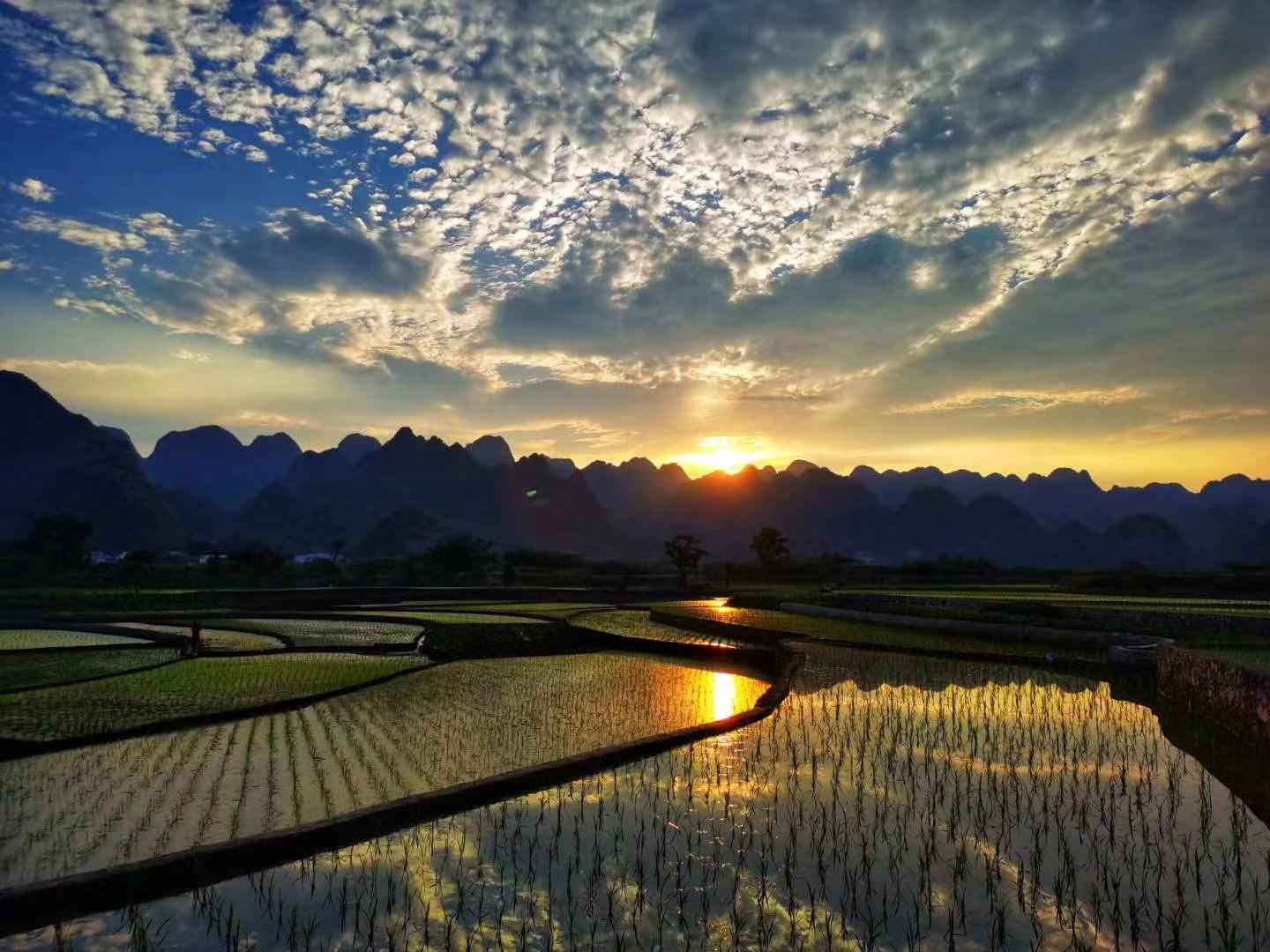
"Ten Thousand Peaks Forest" — nearly 20,000 cone-karst peaks over hundreds of square kilometres. In 1638 the traveller Xu Xiake stood here and noted that these mountains are unlike Guangxi's and unlike Yunnan's — remarkable, he wrote, for standing crowded and sheer. Ride a bike through the middle of it.
Wanfenglin guide →
How it was made →
Visiting with a toddler →
A 100-metre-deep slot canyon that splits the earth right beside the city, its walls hung with waterfalls — dozens of them after rain. Walkways run along and across the gorge.
A vast reservoir lake wrapped in karst hills on the border of three provinces — boat trips, quiet fishing villages, and some of the region's best sunsets.
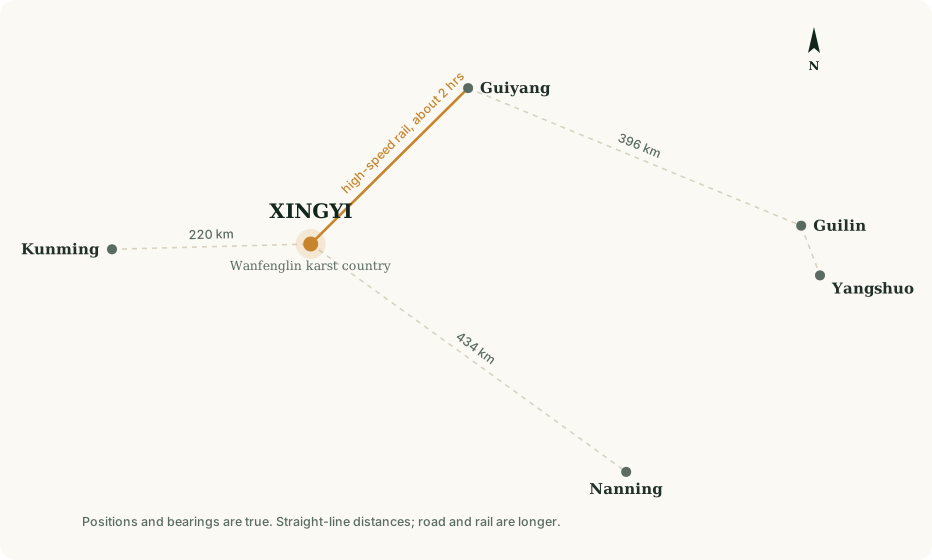
The Panxing high-speed railway opened in November 2025, connecting Xingyi to China's national HSR network. From Guiyang it's about two hours; from Kunming, connect through Panzhou. Xingyi also has its own airport with flights from several major cities.
Xingyi sits almost exactly between the two classic backpacker regions of southwest China — Yangshuo/Guilin to the east and Yunnan to the west. If you're doing that route, this is the stop everyone else is missing — we've written up the Yangshuo → Xingyi → Yunnan route in full, including an honest account of what the detour costs you.
Still choosing where in Guizhou to go? Most "hidden Guizhou" writing sends you east to the Miao and Dong villages and skips the karst west entirely — we compare the two halves honestly in eastern vs western Guizhou.
Two things are ready to book below — but the real service is simpler: an English-speaking local on call. The smart move before any Xingyi trip is to save our WhatsApp — your real-time fallback for anything that goes wrong on the ground, in a city with almost no English service. See what we help with.
We collect you from your hotel, drive you out, sort the electric buggy or bikes with the rental shop in Chinese — child seat and child helmet if you need them — and then leave you to it. Message us when you are ready and we come and fetch you.
Met off your flight or train with your name on a sign, driven to your hotel, and we stay until you are checked in — the step that actually goes wrong when nobody at the desk speaks English.
Rather see Xingyi deeply and at your own pace than on a fixed package? We design a trip — or a longer stay — around you, with English-speaking local support on the ground, and quote once the plan is set.
Those are the two ready-to-book pieces. Anything else you need arranged in Xingyi or Qianxinan — transport, hotels, an interpreter, a business or research or photography visit — tell us what you are trying to do and we will tell you honestly what we can set up.
Most English pages about Wanfenglin stop at the view. We've gone further, cited our sources, and said plainly where the received story does not survive checking.
A tropical seabed 250 million years ago, and why the villages sit exactly where they sit. Includes what Xu Xiake really wrote here in 1638 — not the line everyone quotes, which turns out not to be his.
Xingyi was called Nanlong until 1797. The name was changed as a reward for putting down a Bouyei rising. Almost no visitor is ever told this.
Our reading list, checked. Free sources linked — and an honest account of what simply does not exist in either language.
Two internets, one valley, and your own expectation. Compare how Chinese and English online worlds generate Wanfenglin, then make your own version of the landscape.
Field notes from Guizhou Province, for people who build things — starting with why China keeps its cloud in its poorest province.
Festivals, fashion weeks and film festivals in Guizhou Province, announced in Chinese on WeChat and invisible in English — each one here with its programme, its source, and how a foreign visitor actually gets in.
Whether you are coming for travel, fieldwork, business, photography, study, or a first look at the region, we help you understand Xingyi and arrange what you need on the ground. Start with when to come (and what the valley looks like each season), then how long you actually need, and the thing that catches people out: not every Chinese hotel can register a foreign passport. If you're thinking of staying longer than a trip, we've written about slowing down in Xingyi for a while. After that, ask us anything — a real person here answers, whether or not you ever book a thing.
Plan your trip Email us: hello@visitxingyi.com