
Home / Hidden China
Field notes from the parts of China the English internet doesn't cover — for people who build things.
Verified events across Greater China a foreign visitor can actually attend — each with programme, source and how-to-register in English, and the densest coverage in Guizhou, where we live. All events →
Kaili City Basketball League (KBA) in Kaili.
Auntie Basketball Series in Leishan.
2026 Zhenyuan 3x3 Basketball Open in Zhenyuan.
20 Aug 2026 · Why China Keeps Its Cloud in Its Poorest Province — Tencent's mountain full of servers, Apple's Chinese iCloud, and the three things a tech traveller can actually experience: FAST, the world's highest bridge, and the Wanfenglin karst. (The Guizhou special)
A rolling stream, newest first — short, source-checked items added most weeks. Features arrive every couple of weeks.
Miao silver ornament forging (苗族银饰锻制技艺) entered China's national intangible heritage list in the first batch, 2006, as item 390 under code Ⅷ-40, declared by Leishan county in Guizhou (贵州省雷山县) and held by the Leishan County Intangible Cultural Heritage Protection Centre (雷山县非物质文化遗产保护中心). The entry is specific about geography: the county's silversmiths are concentrated in Kongbai, Maliao and Wugao (西江镇的控拜、麻料、乌高), three villages in Xijiang town. It counts 30 steps from drawing to carving and assembly — casting, hammering, welding, plaiting, washing. Why it matters: the state's own record, not a tour operator, tells you which three villages to aim for. We have not been ourselves; the entry lists no workshop, no address and no way to visit, and says the skill is handed on inside the family. Practicalities are in our travel tips for Guizhou. Source: China Intangible Cultural Heritage Network, national representative project list entry for Miao silver ornament forging (announced 2006, first batch) · checked Sep 2026
Order No. 761, China's interim regulations on unmanned aircraft flight (无人驾驶航空器飞行管理暂行条例), took effect on 1 January 2024. Airspace above a true height of 120 m is controlled; outside controlled airspace is flight-permitted airspace (适飞空域) for micro, light and small drones. There, micro and light drones need no flight application and no operator licence, though the owner must register under their real name; unregistered flight draws a fine of up to ¥200. Micro means an empty weight under 0.25 kg and a maximum true height of 50 m. Why it matters: the lightest drones are legal to fly on the day, no filing, no licence. We have not flown here ourselves; the regulation leaves the exact limits of controlled airspace to air traffic management agencies, published by city-level governments and above, so check before launching over Wanfenglin, the Forest of Ten Thousand Peaks. Source: State Council and Central Military Commission, Interim Regulations on the Flight Administration of Unmanned Aircraft, Order No. 761 (28 June 2023) · checked Sep 2026
The Ministry of Ecology and Environment keeps a directory of facilities open to the public, and the Guizhou section's second-batch list (第二批开放设施单位名录) includes Guiyang Zhongdian Environmental Protection Power Generation (贵阳中电环保发电有限公司), a plant at Yanlou in Huaxi district, Guiyang that takes 1,200 tonnes of household waste a day and 438,000 tonnes a year. Its first two units passed into commercial operation on 14 March 2018, and the entry publishes a contact number, 0851-88641510. Why it matters: a working incinerator is infrastructure you normally only read about, and here the ministry's own listing hands you the phone number. We have not been there ourselves; the entry, dated 27 September 2019, gives no opening hours, no visiting procedure and no sign that English is spoken — call first. Getting there: our Guiyang to Xingyi route notes. Source: Ministry of Ecology and Environment, facilities open to the public directory (27 September 2019) · checked Sep 2026
In March 2025 the Civil Aviation Administration of China issued the first batch of Air Operator Certificates for civil human-carrying pilotless aerial vehicles. One holder is Hefei HeYi Aviation Co., Ltd., a joint venture of the maker of the EH216-S; the announcement says the public can purchase flight tickets for low-altitude tourism and urban sightseeing at operation sites in Guangzhou and Hefei, and it names an Urban Air Mobility Operations Center at Luogang Central Park in Hefei. Why it matters: this is a paid seat in an autonomous aircraft, sold as sightseeing rather than staged as a demonstration. We have not been there ourselves; this is the operator's own announcement, dated March 2025, and it states no price, booking channel or flight schedule — check those before you plan around it. Practicalities in our China travel tips. Source: EHang company announcement (30 March 2025) · checked Sep 2026
Hunan was the first province to take low-altitude airspace management reform province-wide, and the paperwork moved with it. Airspace below 3,000 m is divided into 171 blocks — controlled, monitored and reporting — with 97 routine visual routes planned. Flights touching controlled airspace still need an application by 15:00 the previous day and approval by 21:00; flights that stay in monitored or reporting airspace need only be filed two hours before take-off, on the Xiang Fei Jiu Fei (享飞就飞) app. Why it matters: light-aircraft flying here is becoming a same-day arrangement rather than a day-ahead one. We have not been there ourselves; the briefing lists experience flights among the new businesses the province intends to cultivate, but names no operator, price or booking channel — treat it as direction of travel, not a bookable seat. Practicalities in our China travel tips. Source: Hunan Provincial People's Government portal (8 May 2022) · checked Aug 2026
Under Jinzi Mountain at Baitao, outside Fuling in Chongqing, sits a nuclear complex nobody finished. Work on the 816 project (816工程) stopped in 1984, with 85 percent of the construction and 65 percent of the equipment installation done, leaving the void: a main cavern 79.6 m high, 18 large chambers, and more than 130 roads, side tunnels and vertical shafts. It was declassified in 2002 and opened to visitors in April 2010. Why it matters: China's only declassified nuclear reactor is infrastructure you can walk into rather than read about, and Chongqing to Fuling is an hour by high-speed train. We have not been there ourselves; our source gives no ticket price, hours or photography rule — check those before travelling, alongside the general practicalities in our China travel tips. Source: Chongqing Municipal Local Chronicles Office (16 Aug 2021) · checked Aug 2026
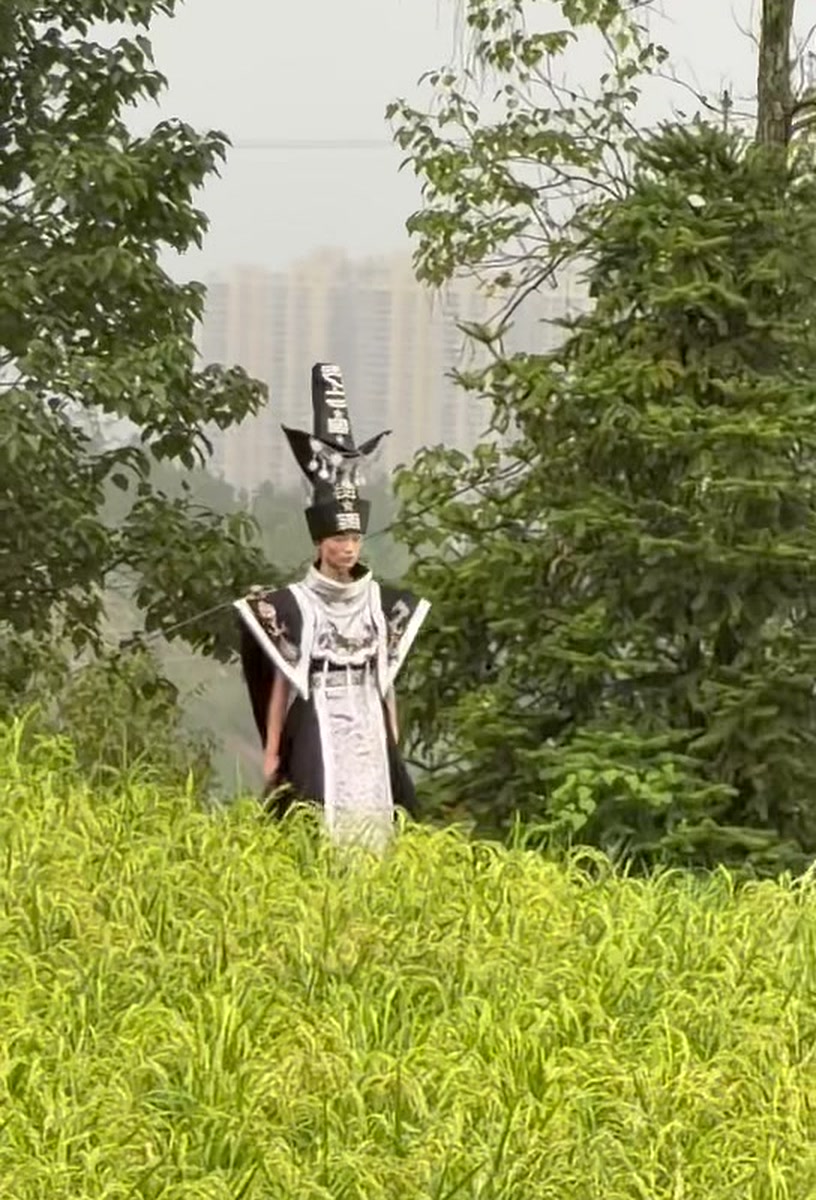
The rain came in hard halfway through the opening runway on 25 August, and the models kept walking anyway. Full photos and programme → Source: our own visit, 25 Aug 2026
Lenghu, a town in Qinghai's Haixi prefecture, lives under China's first local dark-sky statute. The Haixi prefecture regulations on protecting the Lenghu astronomical observation environment (海西蒙古族藏族自治州冷湖天文观测环境保护条例) took effect in January 2023, drawing a dark-sky core zone 50 km out from the boundary of the observatory site — the town included. Article 9 controls the type and brightness of light sources and requires every fixed outdoor night-time light to be aimed at least 30 degrees below the horizontal. It has teeth: prosecutors drove an 800 km round trip after hotels ran rooftop floodlights straight up, and once those were re-aimed and dimmed, observatory staff reported the bright spot in the telescope had disappeared. Why it matters: the dark sky over Lenghu is a legal condition, enforced, not an accident of geography. We have not been there ourselves. Sources: Supreme People's Procuratorate, republishing Fangyuan (15 Aug 2023) · checked Aug 2026
Most people who want to see Miao embroidery and silverwork time a trip around a festival, which means one weekend a year and a great deal of company. Kaili, the prefecture seat of southeast Guizhou, has quietly solved that: the Xiuli Tao heritage market (绣里淘) has run inside the Miao and Dong Cultural Park since September 2023, every Wednesday to Saturday, dawn to dusk, along four lanes — Guandong, Guanxi, Yudong and Yuxi. Several hundred traders and makers set out embroidery, batik and silver; one report counted over a thousand distinct heritage products across the stalls. Look for the horsehair embroidery — real horsehair wrapped inside white thread, stitched by hand. Why it matters: the thing foreign visitors assume is a once-a-year festival spectacle is, in Kaili, a working market four days out of seven — and Kaili South sits on the Shanghai–Kunming high-speed line. We have not been ourselves. Sources: China News Service Guizhou (8 Jun 2024), The Paper (5 Aug 2024) · checked Aug 2026
FAST, the 500-metre radio telescope in Pingtang, sits inside a radio-silence zone that has the force of law. Guizhou's protection measures, in effect since 1 April 2019, draw a 5 km core zone (with looser rings out to 30 km) in which carrying a phone, digital camera, tablet, smartwatch, walkie-talkie or drone is an offence, fined ¥1,000 to ¥30,000. So the visit runs on the telescope's terms: book ahead through the official 中国天眼科普基地 channel, deposit every electronic device at the visitor centre, then ride the shuttle up to the viewing platform. Ticket, shuttle and quota figures disagree across sources — confirm on the official channel. Why it matters: the one place in China where the law takes your phone off you is also the largest filled-aperture radio telescope on Earth. We haven't been there ourselves. Sources: Guizhou provincial quiet-zone protection measures, in force 1 Apr 2019 (CNR/Sina reports, 30 Mar 2019; Ningxia government repost, Apr 2019), Pingtang county government (28 Nov 2022), zgtianyan.com official visitor notices · checked Aug 2026
Zhongwei sits where the Yellow River meets the Tengger Desert, and now holds 16 large and ultra-large data centres serving over 4,000 companies — one of the ten national clusters named in China's 2022 "east data, west computing" plan. The draw is climate: Xinhua reported on 18 August 2026 that facilities there run on free air cooling eight to ten months a year, with green power above 80 percent at China Mobile's site, some of it fed straight from a neighbouring solar farm. Sixteen kilometres out of town is Shapotou — a 5A scenic area with China's largest natural sand slide, camel routes over the dunes and a cable car across the river. Why it matters: the desert that makes the cooling cheap is the one you can sandboard down. We haven't been there ourselves. Sources: Xinhua (18 Aug 2026), Global Times (Jan 2025), Ningxia tourism material · checked Aug 2026
Liuzhou, an old heavy-industry city of four million in Guangxi, is quietly China's most electric. Sixth Tone counted 214,000 EVs and more than 21,000 charging points there in January 2025, and EVs take the highest share of new-car sales in the country: 56 percent by that count, above 66 percent for 2024 by Yicai's. The gap is measurement, not doubt. The city added parking bays sized for compact EVs, kerbside charging and free parking; the cars themselves, Wuling and Baojun minis from around ¥30,000, are built in town. Why it matters: the closest thing anywhere to a city redesigned around micro-EVs is 57 minutes by high-speed train from Guilin — and it is where luosifen comes from. We haven't been there ourselves. Sources: Sixth Tone (16 Jan 2025), Yicai Global (25 Feb 2025), Trip.com/TravelChinaGuide timetables · checked Aug 2026
The Huajiang Grand Canyon Bridge opened to traffic on 28 September 2025 with the world's highest deck — 625 m above the Beipan River — and was designed from day one as a destination: a 207 m glass elevator, a tower-top café, glass walkways, bungee. Guizhou's gorges already host an outsized share of the world's highest bridges; the province is openly turning civil engineering into a tourism category of its own. Why it matters: if your idea of sightseeing is megastructures rather than temples, southwest China just became a destination. Sources: CGTN, Smithsonian, HighestBridges.com, eguizhou.gov.cn · checked Aug 2026
The Village Super League ("Cunchao") in Rongjiang County kicked off its fourth season on 2 January 2026 with 137 village teams — more than double 2024 — playing a January–April group phase and knockouts through late July. No transfer fees, no professionals: butchers, farmers and students, with county-fair food stalls and Miao and Dong performances between halves. Foreign visitors increasingly show up; Rongjiang is on the Guiyang–Guangzhou high-speed line. Why it matters: Chinese grassroots culture at full volume, zero staging — and the next season starts in January. Sources: CGTN, People's Daily, Global Times · checked Aug 2026
Since 17 December 2024, Guiyang Longdongbao airport is an entry port for China's 240-hour visa-free transit scheme (54 eligible nationalities, onward ticket to a third country required) — and the permitted stay area is the entire province. Practically: you can land in Guiyang, spend ten days across FAST, the bridge, Rongjiang and Wanfenglin, and fly out, no visa. Why it matters: the paperwork excuse for skipping interior China is mostly gone. Sources: Chinese embassy notices, eguizhou.gov.cn · checked Aug 2026
UNESCO added Xingyi to its Global Geopark network on 27 March 2024: 1,456 km² covering the Wanfenglin cone-karst valley, the Maling River canyon, and Triassic marine-fossil beds ("Xingyi fauna", roughly 240 million years old). Since November 2025 it is also two hours from Guiyang by high-speed rail. We are based here — it is the quiet, uncrowded end of the Guizhou circuit. Why it matters: the least-known stop on this itinerary now carries a global geology designation, and none of the crowds. Source: UNESCO · checked Aug 2026
New field notes land on this page most weeks; features every couple of weeks. Want a digest by email? Write to hello@visitxingyi.com with "brief" in the subject and we'll send a round-up when there's enough worth sending — no list-selling, unsubscribe by replying "stop". Coming to any of these places? Message us on WhatsApp — we're the English-speaking team on the ground in Guizhou.